Currently with the COVID-19 virus chasing through the globe, one can not stop wondering about the secondary effects that might alter people’s life’s after battling the corona infection. As no one exactly knows if this new virus type has long-lasting effects in the hosts body, we can only deduct and speculate from existing data from previous and similar viruses. Here, I will briefly discuss the effect of the immune system on the bone, and the lessons to be learned from the past acute respiratory syndrome (SARS) coronavirus.
Osteoimmunology is the field which studies the crosstalk and interactions between the skeletal and immune system. An important player in this crosstalk is the RANK/RANKL/OPG signaling pathway. The RANK receptor is expressed by osteoclasts, whereas the RANK ligand (RANKL) is expressed by stromal cells, osteoblasts and immune cells. Additionally, it is found in soluble form within the bone marrow as these cells can secrete RANKL. When the RANKL binds to its receptor, it stimulates osteoclast maturation, activation and survival. To antagonize this signaling pathway, osteoprotegerin (OPG) also has the ability to bind the RANK receptor, thereby preventing RANKL from its binding. Several cytokines, such as interleukin-1 (IL-1), IL-6, IL-17 and tumor necrosis factor α (TNFα) stimulate RANKL expression. Therefore, upon activation of the immune system, activated T and B cells induce osteoclastogenesis, by either directly expressing RANKL, or indirectly by expressing IL-17. Interestingly, in physiological conditions B cells secrete OPG, thus countering the osteogenesis caused by RANK/RANKL signaling. Hence, chronic inflammation might lead to increased bone resorption, giving rise to osteopenia. Due to the fact that viruses activate the immune system, they too might increase bone resorption. Studies have already shown a link between human immunodeficiency virus (HIV) and infection/acquired immunodeficiency syndrome (AIDS) in the formation of osteoporosis, as concomitantly an increase in B cells RANKL expression facilitates bone resorption (Criscitiello et al., 2015; Weitzmann, 2017)
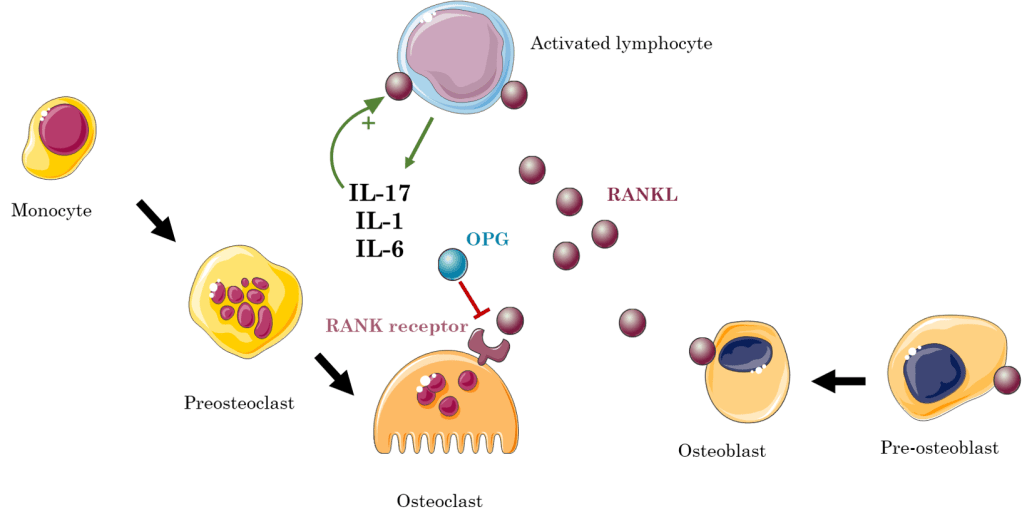
After the outbreak of SARS caused by the SARS coronavirus (SARS-CoV) in 2002, in which patients were treated short-term with high doses of corticosteroids, several reports indicated that recovered SARS patients showed osteonecrosis of hip and knee and reduced hip bone mineral density, which correlated in a dose-correlated manner with the steroid treatment (Griffith et al., 2005; Lau et al., 2005). However, a study by Obitsu and colleagues in 2009 showed that the angiotensin-converting enzyme 2 (ACE2) receptor to which SARS-CoV binds is partially expressed by CD14+ monocytes, a possible precursors of osteoclasts. Furthermore they described that the expression of 3a/X1, an accessory protein of the SARS-CoV, enhanced osteoclastogenesis by increasing RANKL expression in mouse stromal ST2 cells and by enriching the RANKL presence on murine macrophage cell line (Obitsu et al., 2009). This data suggests that upon infection with the virus, more RANKL is produced to bind to their receptor on the osteoclasts, stimulating their maturation and activity, as well as increased susceptibility of monocytes to RANKL, as they generate more receptors.
Notwithstanding, these publications do not anticipate any causal effect between the current coronavirus and bone health, as the previous described bone loss was mainly caused by the steroid treatment, and the direct evidence of SARS-CoV and osteoclastogenesis is limited to in vitro experiments conducted in murine cell lines. Currently, in this pandemic we still don’t know any long-lasting effects caused by the virus, as currently the focus is to prevent its spread and finding a vaccine. If COVID-19 or the immunological response thereon affects bone mass is to be elucidated in the following years.
#COVID-19, #coronavirus #bonebiology #SARS #osteoimmunology
References:
Criscitiello, Carmen, Viale, Giulia, Gelao, Lucia, Esposito, Angela, De Laurentiis, Michele, De Placido, Sabino, Santangelo, Michele, Goldhirsch, Aron and Curigliano, Giuseppe (2015) ‘Crosstalk between bone niche and immune system: Osteoimmunology signaling as a potential target for cancer treatment’, Cancer Treatment Reviews. Elsevier Ltd, 41(2), pp. 61–68.
Griffith, James Francis, Antonio, Gregory Ernest, Kumta, Shekhar Madhukar, Hui, David Shu Cheong, Wong, Jeffrey Ka Tak, Joynt, Gavin Matthew, Wu, Alan Ka Lun, Cheung, Albert Yu Kiu, Kwok, Hing Chiu, Kai, Ming Chan, Ping, Chung Leung and Ahuja, Anil Tejbhan (2005) ‘Osteonecrosis of hip and knee in patients with severe acute respiratory syndrome treated with steroids’, Radiology, 235(1), pp. 168–175.
Lau, E. M. C., Chan, F. W. K., Hui, D. S. C., Wu, A. K. L. and Leung, P. C. (2005) ‘Reduced bone mineral density in male Severe Acute Respiratory Syndrome (SARS) patients in Hong Kong’, Bone, 37(3), pp. 420–424.
Obitsu, Saemi, Ahmed, Nursarat, Nishitsuji, Hironori, Hasegawa, Atsuhiko, Nakahama, Ken ichi, Morita, Ikuo, Nishigaki, Kazuo, Hayashi, Takaya, Masuda, Takao and Kannagi, Mari (2009) ‘Potential enhancement of osteoclastogenesis by severe acute respiratory syndrome coronavirus 3a/X1 protein’, Archives of Virology, 154(9), pp. 1457–1464.
Weitzmann, M. Neale (2017) ‘Bone and the Immune System’, Toxicologic Pathology, 45(7), pp. 911–924.

 Bone Biology & Beyond