Osteoporosis is characterized by a decreased bone mass, leading to fragile bones more prone to fractures. This is caused by an imbalance in bone formation, when the bone-forming osteoblasts cannot catch up with the bone-resorbing osteoclasts. Previously, drugs used for the treatment of osteoporosis, such as bisphosphonates and denosumab, focused on inhibiting the bone resorption, which, when given intermittently, is effective for a period of time, however, after time this effect wears off and might even lead to serious side effects. Recently, two new osteo-anabolic drugs have been released into the marker, namely Romosozumab and Blosozumab, both monoclonal antibodies targeting sclerostin.
Sclerostin is an important regulator of the Wnt signaling pathway. When Wnt signaling is activated (‘WNT ON’), Wnt ligand binds to the low-density lipoprotein receptor-related protein 5/6 (LRP5/6) and FZD co-receptors, resulting in the intracellular phosphorylation of LRP5/6. This induces the inactivation of the destruction complex, which consists of dishevelled (DVL), AXIN, casein kinase 1 (CK1) and glycogen synthase kinase 3 beta (GSK3β), as it will localize to the cell membrane where its kinase activity is inhibited. This allows non-phosphorylated β-catenin to accumulate and translocate to the nucleus, where its transcriptionally active. Sclerostin (Scl), however, works as a Wnt signaling antagonist, as it binds to the LRP co-receptors, preventing their interaction with the Wnt ligands (‘WNT OFF’). This leads to the phosphorylation of β-catenin by the destruction complex, thereby labelling it for ubiquitination and proteasomal degradation.
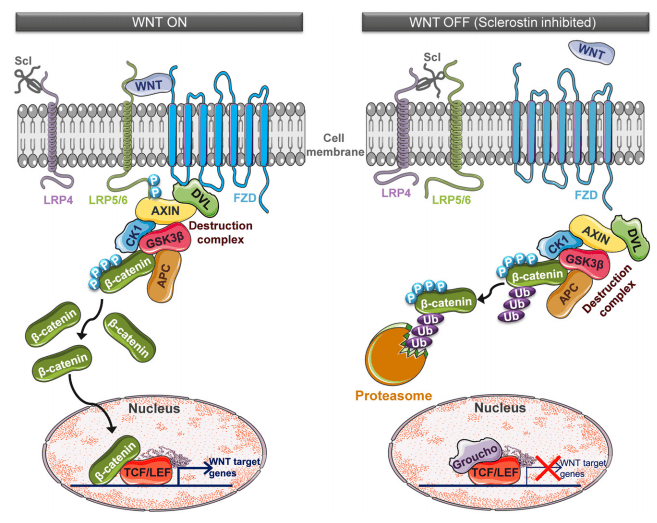
Image taken from Holdsworth, Gill, Roberts, Scott J. and Ke, Hua Zhu (2019) ‘Novel actions of sclerostin on bone’, Journal of Molecular Endocrinology, 62(2), pp. R167–R185
As sclerostin normally prevents the activation of Wnt signaling, resulting in decreased bone formation capacity, the inhibition of sclerostin stimulates bone formation, making it a potential effective osteo-anabolic treatment.
Reference:
Holdsworth, Gill, Roberts, Scott J. and Ke, Hua Zhu (2019) ‘Novel actions of sclerostin on bone’, Journal of Molecular Endocrinology, 62(2), pp. R167–R185.
 Bone Biology & Beyond